


Showing posts with label Koenigsegg. Show all posts
Showing posts with label Koenigsegg. Show all posts
Friday, August 6, 2010
Saab has shown the new car 9-5

The model equipment has been expanded at the expense of adaptive headlights, the cruise-control and system of displaying of the information on a windshield. Also, modern Saab 9-5 has received the new chassis and system of start of the engine without the ignition key.
Sunday, March 28, 2010
2011 Koenigsegg Sports Car Agera - Celebrate 15 Years

Geneva Motor Show 2010 - The new Koenigsegg Agera. To celebrate 15 years of making dream cars, Koenigsegg unleash their latest jewel, the Koenigsegg Agera. A new supercar aimed to take the Koenigsegg experience to the next level, both on the road and the track.

2011 Koenigsegg Agera
The Agera is on display at the 80th Salon International de l’Auto in Geneva. The Agera shares some styling tweaks that are similar to the CCX and owes its name to the Swedish translation of “to act”, thus symbolizing the Koenigsegg philosophy of always improving its cars and pushing its designs to the limit.

2011 Koenigsegg Agera
Koenigsegg Agera is powered by Twin Turbo engine with 910 hp in term of running on regular petrol. Coming on to the major details, based on the regular CC, the Koenigsegg Agera boasts of a 4.7-liter twin turbocharged V8 producing 910 PS (669 kW/898 hp) at 6850 rpm and 1100 Nm (811 lb-ft) at 5100 rpm. There is over 1000 nm of torque available from 2680 to 6100 rpm.

2011 Koenigsegg Agera
To balance this, the Agera features the latest in braking technology with 392×36 and 380×34 ventilated and drilled ceramic discs. When combined with a dry weight of just 2,832 lbs and the sequential gearbox the Agera can sprint to 100 km/h in as little as 3.1 seconds, 200 km/h (124 mph) in 8.9 seconds and blast on to a top speed of 245+ mph. As well, new traction control is fitted with auto adapt functionality for different road conditions and driving styles as well as several manual settings.

2011 Koenigsegg Agera
Koenigsegg’s designers have tried to push through some difference via the slightly modified front and rear bumpers. However the car’s carbon-Kevlar body, removable top that stores into the bonnet and aluminum honeycomb reinforced carbon fiber chassis, all keep it close to the outgoing CCX.

2011 Koenigsegg Agera
The distinguishable additions are the all-new carbon fibre center console and tunnel assembly and the new type of ambient lighting called “Ghost Lights” where illumination shines through the car’s billet aluminum buttons and surfaces by way of invisible nanotubes.

2011 Koenigsegg Agera
Beside the new engine performance, Koenigsegg also features the new Koenigsegg Agera stitching and seams for Agera interior and has developed a new type of interior illumination, which shines through the billet aluminum buttons and surfaces by way of invisible nanotubes.

2011 Koenigsegg Agera
The Koenigsegg Sports Car Agera will be produced in parallel to the Award winning CCX and CCXR models. The pre-production show car will be put through its phases for the coming six month prior to the production car launch of the Agera. Pricing details have not been revealed as of now but it is being said that the supercar maker will bring a pre-production model of the Agera to the Swiss Motor Show. According to GTSpirit, just 16-20 Agera models will be built each year, starting later this year.
Tuesday, March 2, 2010
Geneva 2010: Koenigsegg Agera is the Swedish supercar evolved

Talk about a super way to kick off the 2010 Geneva Motor Show. And yes, we intend the pun. We all know and love the Koenigsegg CCX, but it's getting a bit long in the tooth, at least as far as supercars go. Introduced to the world at large at (no surprise) 2006 Geneva Motor Show, the Swedish rocket has wowed enthusiasts for the past five years. But that was then-and in the case of biofuled, 1,100 horsepower monster CCXR, then was a few months ago-the Agera is now.
Designed to stay ahead of the hypercar curve, the Agera can be thought of as an evolution of the CCX. If the previous Koenigsegg had any flaw, it was its slabby, just kinda... there looks. The Agera changes that, with a much more sculpted, almost pinched front end. We find it much more attractive than the CCX, but as always, judge for yourself. Other design highlights include the wheels that generate a vortex in order to better suck hot air away from the brakes. You've also got the oval doughnut taillights, the doughnut part meaning that hot air escapes the engine bay via holes in the taillights. Pretty cool, no?
Of course, what we really care about is what lies under the Agera's carbon fiber skin. It's the same 4.7-liter built-in-house Koenigsegg V8 from the CCX, but with a twist. Unlike the dual-superchargers found on the CCX, the Agera's engine gets twin-turbos. Power is typically bonkers, with 910 hp at 7,250 rpm. Though the real story might be the force-inducted torque. Are you sitting down? 738 pound-feet of the stuff is available from 2,680 rpm to 6,170 rpm, with a torque peak of 811 lb-ft. Also, we should point out that the Agera weighs 2,832 pounds.
The (manufacturer claimed) numbers are equally head spinning. Zero to sixty miles an hour takes 3.1 seconds, 0-124 mph happens in 13.7 seconds and the top speed is somewhere north of 245 miles per hour. The top speed might be (slightly) down from the CCXR (supposedly that beast can go faster than 250 mph) but check out the road-holding. Koenigsegg is claiming that the Agera can pull 1.6 g. Holy Swedish moly, man.
Saturday, October 3, 2009
Koenigsegg CCR Design Sport Car Concept
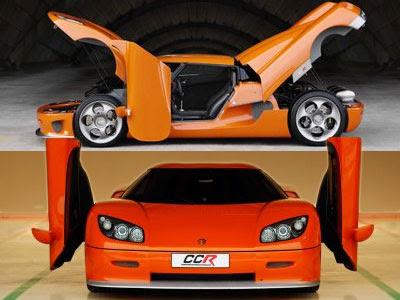 Koenigsegg CCR Design Sport Car Concept
Koenigsegg's design seeks to give an interpretation of strength and flowing motion. The body of a Koenigsegg is formed for one ultimate purpose; speed. Its beauty is the beauty of speed itself. The surfaces are shaped to perfectly aerodynamic, an appearance that does not deceive. All aspects of this machine serve its one fundamental objective. Both the body and chassis of a Koenigsegg are made of extremely lightweight carbon fibre composite, reinforced with Kevlar and aluminium honeycomb. Its race-bred suspension system brings the driver in control of all movement, even under the toughest racing conditions.
The car was styled by Christian von Koenigsegg himself but its shape is largely dictated by aerodynamics. It is not as striking as Pagani or Enzo. At some angles it even looks bulky, like a big whale. But the whale delivers a sense of power that you can't find in its rivals either. Because of the targeted top speed, the body is designed to be so smooth that it has a very low drag coefficient of 0.30. This is much lower than Enzo (0.36), SLR (0.37) and Carrera GT (0.39). Unsurprisingly, the downside is a rather low downforce, just 50kg at the front and 70kg at the back. For comparison, an Enzo generates 775kg while Pagani achieves 500kg.
The chassis is constructed like other supercars. Central to it is a carbon-fiber tub (Koenigsegg called it "semi-monocoque") attached with steel subframe up front and aluminum subframe at the rear for mounting engine, gearbox and suspensions. Chassis rigidity is 28,100Nm per degree despite of the targa roof. The whole bodyshell is also carbon-fiber. Koenigsegg claims a dry weight of 1175kg, which translates to 1275kg when fluid and fuel are loaded, i.e., what we usually refer to "kerb weight". In other words, CC8S is about as light as Pagani and Saleen S7, while being around 100 kilograms lighter than Enzo and Carrera GT.
The car was styled by Christian von Koenigsegg himself but its shape is largely dictated by aerodynamics. It is not as striking as Pagani or Enzo. At some angles it even looks bulky, like a big whale. But the whale delivers a sense of power that you can't find in its rivals either. Because of the targeted top speed, the body is designed to be so smooth that it has a very low drag coefficient of 0.30. This is much lower than Enzo (0.36), SLR (0.37) and Carrera GT (0.39). Unsurprisingly, the downside is a rather low downforce, just 50kg at the front and 70kg at the back. For comparison, an Enzo generates 775kg while Pagani achieves 500kg.
The chassis is constructed like other supercars. Central to it is a carbon-fiber tub (Koenigsegg called it "semi-monocoque") attached with steel subframe up front and aluminum subframe at the rear for mounting engine, gearbox and suspensions. Chassis rigidity is 28,100Nm per degree despite of the targa roof. The whole bodyshell is also carbon-fiber. Koenigsegg claims a dry weight of 1175kg, which translates to 1275kg when fluid and fuel are loaded, i.e., what we usually refer to "kerb weight". In other words, CC8S is about as light as Pagani and Saleen S7, while being around 100 kilograms lighter than Enzo and Carrera GT.
Wednesday, September 16, 2009
Very limited series of supercar Trevita

The Swedish autocompany Koenigsegg has presented the new supercar Trevita.
Trevita is the limited release of model Koenigsegg CCXR with a body from exclusive carbon plastic with diamond processing.New unique method of manufacture of a carbon fibre named The Koenigsegg Proprietary Diamond Weave. On each fibre put a diamond covering.
The car will receive doubled a spoiler, an exhaust system from a special alloy inconell, ceramic brakes (from ABS), safety pillows, underwheel switches of drives, information-entertaining system and system of monitoring of tyres.
In total will assemble three cars Trevita.
Wednesday, March 4, 2009
NLV Quant by Koenigsegg

The cars created by Christian von Koenigsegg are not renowned for being environmentally friendly. The car unveiled by Koenigsegg today at the Geneva Motor Show is in many ways diametrically opposed to the CCX supercar and its many variants. Rather than burning fuel to produce prodigious quantities of horsepower, the Quant is designed to run silently on electrons. What was revealed on the show floor today is a styling buck of a four-passenger, gull-winged coupe with an electric motor driving each rear wheel. The combined output of the powertrain is expected to be 512 hp and 527 lb-ft of twist.
Koenigsegg has partnered with NLV Solar AG for the energy storage system of this electric coupe. As the name implies, NLV's main line of business is solar panels and those have been incorporated into the hood and roof of the Quant. Talking with Christian von Koenigsegg and Nunzio La Vecchia of NLV, they acknowledged that the solar cells will only provide enough power for accessories such as the radio or ventilation and won't be able to do any significant battery charging.
Friday, August 22, 2008
Koenigsegg developing 700bhp four-door

We've seen stretched out exotics before, but Koenigsegg is reportedly planning on producing a model with four doors right from the factory. Carbon-fiber saloons from the Swedish automaker have been undergoing testing for the past two years, with the new model set to be debut in concept form at the Geneva Motor Show in 2010. Sales of the car are planned for 2011 with a sizable allocation destined for the U.S. The other big market for the brand is the Middle East, where much of the development money is said to have been sourced. Powered by a 700-horsepower V8 not shared with Koenigsegg's other exotics, the new super saloon is expected to surpass 200 miles per hour. Pricing would almost surely be higher than its closest rivals, the upcoming Porsche Panamera and Aston Martin Rapide, but lower than the marque's other carbon creations.
Saturday, December 1, 2007
Koenigsegg CCX and CCXR Limited Editions

Due to request from certain Koenigsegg Clients and Customers, Koenigsegg has created a Limited Edition version of it’s sought after cars. The Koenigsegg Edition comes in two limited versions, the CCX and CCXR models.
It features a 5.0L twin supercharged Koenigsegg engine, together with many other unique features. The car is more track biased compared to the standard models, as it has stiffer springs and anti-roll bars, reset dampers and lowered chassis. It also features a fully visible carbon body a large adjustable rear wing, larger front splitter and side strakes for increased down force and a unique forged wheel design.
The interior is also reworked and features; color matched leather carpets, Edition side step plates, Edition chronograph instrument cluster, New edition only layout for the center consol control panels.
All other extra equipment comes as standard, such as Carbon Wheels, Special interior trim and color, Rearview camera, Satnav or Bluetooth, Amplifiers, complete Inconell exhaust system in order to save weight.
The Edition cars will be built in two different versions, a CCX model limited to 14 cars with 888 bhp and a CCXR (Bio flexi fuel) model limited to 6 cars with 1018 bhp. The price for the 888 hp CCX is 1 330 000 Euro, and 1 500 000 Euro for the 1018 hp CCXR (E85/petrol flex fuel) version. The two first of each version are already spoken for.
CCX Edition Technical Specification
Performace
Acceleration: 0-100 km/h (0-62 mph) 2.9 seconds.
0-200 km/h 9.2 sec, 0-200-0 km/h 14 sec
Top speed: 400+ km/h (245+ mph).
Braking distance: 32m (100–0 km/h)
Lateral G-force: 1.4 G
Weight to Power ratio: 1.44 kg/hp
Weight distribution %: 45% front, 55% rear
Fuel consumption: Highway travel: 13 l/100 km
Combined: 17 l/100 km
Body
Two-door, two-seater with removable hardtop
stowable under the front hood lid.
Composite Group System. Total Body weight 56 kg
Dimensions
Total length: 4293 mm (169”)
Total width: 1996 mm (78.6”)
Total height: 1120 mm (44,1”)
Ground clearance: 100 mm (3.9”)
Fuel capacity: 70 litres (18,5 gallons US)
Luggage compartment: 120 litres (31,7 gallons US)
Dry weight: 1280 kg (2821LBS) (Fully equipped with: Airbag, Glass roof and rear window, power windows, ABS, soundinsulation, lifting system, Power steering and power brakes)
Aerodynamics
Cd. 0,33 Frontal area 1.867 m2
Flat underside of chassis. Venturi tunnels at rear of chassis/body.
Steering
Rack and pinion power assisted steering. 2.7 turns lock to lock.
Turning circle: 11 metres.
TRW electrohydraulic power assisted.
Chassis
Front and rear suspension: Double wishbones, chnical adjustable ups Racing gas-hydraulic two way adjustable shock absorbers, pushrod operated. Anti-roll bar.
Electronically adjustable ride height.
with aluminium honecomb and integrated fueltanks for optimal weight distribution and safety. Monocouqe torsional rigidity: 58.000 nm/degree. Weight including tanks: 72 kg
Front: Cr Mo subframe, with integrated crashmembers.
Rear: semi-stressed engine and gearbox with support struts, for optimal rigidity and no engine inertia movements.
Fully machined aircraft aluminium uprights, with SKF LeMans specification 150mm anglecontact ball bearings.
GKN hollow/gundrilled driveshafts.
Integrated pushrod operated VPS dual adjustable gas shockabsorbers.
Koenigsegg Z-style progressive and lightweight anti-roll bars front and rear.
Brakes
Front brakes: Ceramic discs Ø 380 mm, 34 mm wide. 8 piston light alloy Brembo monoblock calipers. Power assisted.
Koenigsegg Advanced Control system.
Rear brakes: Ceramic discs Ø 362 mm, 32 mm wide. 6 piston light alloy AP Racing callipers. Power assisted.
Koenigsegg Advanced Control system.
Traction Control: F1 style for optimal performance with 5 different handling modes.
Wheels
Koenigsegg Carbon / alloy wheels with centre locking.
Front:19” x 9.5”
Rear: 20” x 12.5”
Tyres
Michelin Pilot Sport 2.
Unidirectional with asymmetric tread pattern.
Front: 255/35–19” (Y)
Rear: 335/30–20” (Y)
Transmission
Specially developed 6-speed gearbox.
Torque sensitive, limited slip differential.
Clutch: Dual Plate, Ø 240 mm.
Transversally mounted race style gearbox with limited slip differential. 6 gears plus reverse.
Final ratio: 3,364
1st gear: 2,875
2nd gear: 1,773
3rd gear: 1,267
4th gear: 1,000
5th gear: 0,833
6th gear: 0,711
Reverse gear: 3,000
Engine
Type: Koenigsegg V8 cast aluminium, 4 valves per cylinder, double overhead camshafts.
Displacement: 5.0 litre
Compression: 8.6.1
Lubrication system: Dry sump with oil spray piston cooling.
Oil cooler.
Weight 178 kg including supercharger and drysumpsystem.
Intake Manifold: Koenigsegg milled aircraft aluminium manifold.
Patented response charge system for optimal engine respons.
Manifold ceramic coated.
Emission levels: Euro IV. CARB/EPA Bin 5, with OBDII.
Sequential, multipoint fuel injection.Twin Rotrex centrifugal superchargers with response system 1.5 bar boost pressure.
Hydraulic lifting system: Lifts the front of the car 50mm in 3 seconds, from the press of the button. Automatic drop down safety feature at 50 km/h.
Central electrical system: Digital semiconductors instead of fuses or relays. Can bus operated and fully programmable functionality.
Power output: 888 Bhp at 7.000 rpm.
Maximum torque: 920 Nm (678ftlb) at 5.800 rpm.
CCXR Edition Technical Specification

Performance
Acceleration: 0-100 km/h (0-62 mph) 2.9 seconds.
0-200 km/h 8.9 sec, 0-200-0 km/h 13.7 sec
Top speed: 417+ km/h (250+ mph).
Braking distance: 32m (100–0 km/h)
Lateral G-force: 1.4 G
Weight to Power ratio: CCXR: 1.26 kg/hp
Weight distribution %: 45% front, 55% rear
Fuel consumption: Highway travel: 18 l/100 km (E85)
Combined: 22 l/100 km (E85)
Body
Two-door, two-seater with removable hardtop stowable under the front hood lid.
Composite Group System. Total Body weight 56 kg
Dimensions
Total length: 4293 mm (169”)
Total width: 1996 mm (78.6”)
Total height: 1120 mm (44,1”)
Ground clearance: 100 mm (3.9”)
Fuel capacity: 70 litres (18,5 gallons US)
Luggage compartment: 120 litres (31,7 gallons US)
Dry weight: 1280 kg (2821LBS) (Fully equipped with: Airbag, Glass roof and rear window, power windows, ABS, soundinsulation, lifting system, Power steering and power brakes)
Aerodynamics
Cd. 0,33 Frontal area 1.867 m2
Flat underside of chassis. Venturi tunnels at rear of chassis/body.
Steering
Rack and pinion power assisted steering. 2.7 turns lock to lock.
Turning circle: 11 metres.
TRW electrohydraulic power assisted.
Chassis
Front and rear suspension: Double wishbones, adjustable ups Racing gas-hydraulic two way adjustable shock absorbers, pushrod operated. Anti-roll bar. Electronically adjustable ride height.
with aluminium honecomb and integrated fueltanks for optimal weight distribution and safety. Monocouqe torsional rigidity: 58.000 nm/degree. Weight including tanks: 72 kg
Front: Cr Mo subframe, with integrated crashmembers.
Rear: semi-stressed engine and gearbox with support struts, for optimal rigidity and no engine inertia movements.
Fully machined aircraft aluminium uprights, with SKF LeMans specification 150mm anglecontact ball bearings.
GKN hollow/gundrilled driveshafts.
Koenigsegg Z-style progressive and lightweight antiroll- bars front and rear.
Brakes
Front brakes: Ceramic discs Ø 380 mm, 34 mm wide. 8 piston light alloy Brembo monoblock calipers. Power assisted.
Koenigsegg Advanced Control system.
Rear brakes: Ceramic discs Ø 362 mm, 32 mm wide. 6 piston light alloy AP Racing callipers. Power assisted.
Koenigsegg Advanced Control system.
Traction Control: F1 style for optimal performance with 5 different handling modes.
Wheels
Koenigsegg Carbon / alloy wheels with centre locking.
Front:19” x 9.5”
Rear: 20” x 12.5”
Tyres
Michelin Pilot Sport 2.
Unidirectional with asymmetric tread pattern.
Front: 255/35–19” (Y)
Rear: 335/30–20” (Y)
Transmission
Specially developed 6-speed gearbox.
Torque sensitive, limited slip differential.
Clutch: Dual Plate, Ø 240 mm.
Transversally mounted race style gearbox with limited slip differential. 6 gears plus reverse.
Final ratio: 3,364
1st gear: 2,875
2nd gear: 1,773
3rd gear: 1,267
4th gear: 1,000
5th gear: 0,833
6th gear: 0,711
Reverse gear: 3,000
Engine
Type: Koenigsegg V8 cast aluminium, 4 valves per cylinder, double overhead camshafts.
Displacement: 5.000 cm3.
Compression: 9.2:1
Lubrication system: Dry sump with oil spray piston cooling.
Oil cooler.
Weight 178 kg including supercharger and drysumpsystem.
Intake Manifold: Koenigsegg milled aircraft aluminium manifold.
Patented response charge system for optimal engine respons.
Manifold ceramic coated.
Emission levels: Euro IV.
Sequential, multipoint fuel injection.Twin Rotrex centrifugal superchargers with response system 1.6 bar boost pressure.
Hydraulic lifting system: Lifts the front of the car 50mm in 3 seconds, from the press of the button. Automatic drop down safety feature at 50 km/h.
Central electrical system: Digital semiconductors instead of fuses or relays. Can bus operated and fully programmable functionality.
Power output: 1018 Bhp at 7.000 rpm.
Maximum torque: 1060 Nm (740ftlb) at 5.600 rpm.
Subscribe to:
Posts (Atom)

